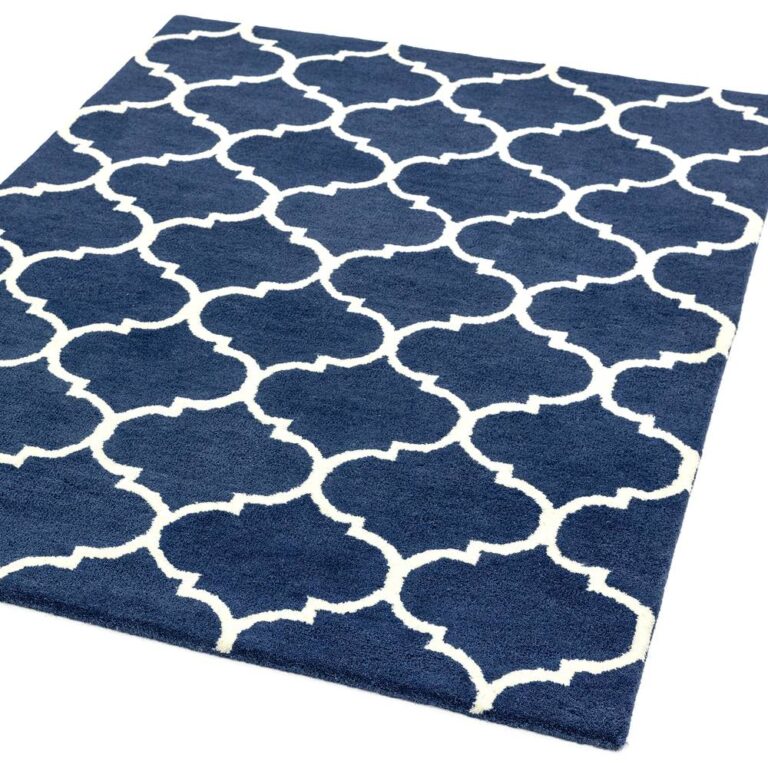


Contemporary rugs are rugs designed in a current style: clean lines, abstract or geometric patterns, bold or deliberately quiet colour, and textured surfaces, rather than the medallions and formal borders of traditional designs. Which one is right for you depends on the size of the room, the colours already in it, and how hard the rug is going to have to work.
Trends come and go, so this guide sticks to what holds up: the main modern styles, how to pick colour and size, and which materials suit which rooms.
What makes a rug contemporary rather than traditional?
A contemporary rug drops the old rules: no central medallion, no formal border, and no need for the pattern to be symmetrical. Traditional rugs, such as Persian rugs, are built around repeated motifs, framed borders and a balanced layout.
| Feature | Contemporary rugs | Traditional rugs |
|---|---|---|
| Layout | Free, asymmetric or all-over pattern | Central medallion with border |
| Pattern | Abstract shapes, geometry, texture or plain | Florals, vines, ornate motifs |
| Colour | Single bold colours, monochrome or tonal | Layered reds, blues and golds |
| Surface | Often textured: carved, high-low pile, shine | Usually an even pile |
| Mood | Calm and minimal, or a deliberate statement | Classic, formal, warm |
People use “contemporary” and “modern” almost interchangeably when they shop for rugs, and so do we. Strictly speaking, modern design points back to the mid-century look, and contemporary means what’s being designed now. For buying a rug, the practical meaning is the same: something that looks of its time and sits comfortably with today’s sofas, floors and paint colours.
What are the main modern rug styles?
Most contemporary rugs fall into a handful of families. Work out which one you keep coming back to and the choice narrows quickly.
Abstract rugs
Abstract rugs use loose, painterly shapes, brushstroke effects, washes of colour or distressed patterns that don’t repeat in a formal way. They’re forgiving in family rooms, because an irregular pattern hides crumbs and footprints. They also suit open-plan spaces, where the rug needs to mark out the seating area without fighting a strong pattern elsewhere.
Geometric rugs
Geometric rugs are built on lines, grids, diamonds and circles. They bring structure, which works in rooms with simple furniture and plain walls. A small-scale geometric reads almost as texture from across the room; a large-scale one becomes the feature. They’re good in hallways too, where a runner with a repeating shape pulls the eye along.
Plain and textured rugs
Plain rugs are one colour, often with a subtle texture or tonal variation. They’re the quietest contemporary choice and the easiest to live with for years. If you’ve got a patterned sofa, busy curtains or a feature wall, a plain rug grounds the room without adding more noise.
High-low pile and carved rugs
High-low pile rugs have areas of longer and shorter pile, so the pattern is cut into the surface itself. Even in a single colour, the shadows make a design that shifts as the light moves round the room. They feel good underfoot and give a minimal room some depth.
High-shine rugs
High-shine rugs use fibres with a sheen that catches the light, so the colour looks slightly different depending on where you stand. They lift a plain modern room, especially in the evening under lamps. Some are made with viscose, which looks lovely but is delicate: it marks easily and doesn’t like spills, so we’d keep a viscose rug for a bedroom or a quieter sitting room rather than a busy family space.
Monochrome rugs
Monochrome rugs use black, white, cream, grey and charcoal, often in strong contrast. Black and cream is a classic pairing that sits as happily on oak floors as on grey carpet, and works with warm or cool paint colours. Our guide to black and cream rugs has ideas for styling one.
Boho rugs
Boho rugs take tribal and folk-style patterns and soften them, often in faded colours. They sit somewhere between modern and traditional, and suit relaxed living rooms, bedrooms and rooms full of plants and natural materials.
Which colours work best for a modern rug?
We’d rather not tell you what colour is “in” for 2026. The rug will be on your floor for years, so choose a colour that works with your room, not a forecast. These are the colours we find easiest to build a modern room around:
- Teal sits between blue and green. It works with cream, grey and natural wood, and brings colour without shouting. Mustard or ochre cushions go well with it.
- Monochrome is the safest bold choice. It adds contrast and goes with almost any sofa.
- Charcoal is a deep grey that hides wear well. It anchors a light room and copes with busy family rooms and hallways.
- Olive is a muted, earthy green. Try it with brown leather, oak and cream walls. If green is your colour, our guide to green rugs for the living room goes further.
- Ochre is a warm, deep yellow that warms up a grey or white room. Use it as one strong accent rather than alongside lots of other colours.
- Greige, somewhere between grey and beige, is the soft neutral for people who want warmth without much colour.
A simple trick: take the colour you like most from a cushion, a print or a picture already in the room, and find a rug that picks it up. The room looks planned, even if everything was bought years apart.
How do you choose a contemporary rug for a modern room?
Work from the room outwards: size first, then how much pattern the room can take, then colour. Most rug regrets come from falling for a design before checking it fits.
- Measure the area. Mark the rug’s outline on the floor with masking tape and leave it for a day. You’ll know straight away whether the size works with your furniture.
- Count the pattern already in the room. If the curtains, sofa or wallpaper are patterned, a plain, textured or tonal rug keeps things calm. If everything else is plain, a bold abstract or geometric rug can be the feature.
- Match the scale. A large pattern looks confident in a big room. In a small room, a smaller pattern or a plain rug stops the floor feeling busy.
- Think about light. A pale rug brightens a north-facing room. A darker rug hides wear in a busy, sunny room and won’t show fading as obviously.
- Think about who’s walking on it. A living room with children and pets needs a durable or easy clean rug. A bedroom rug can be softer and more delicate, because it sees far less traffic.
Can you mix a contemporary rug with traditional furniture?
Yes, and it often looks better than a room where everything matches. A contemporary rug under a traditional wooden dining table, a chesterfield or an antique dresser freshens the room and stops it feeling dated.
The trick is to link the two with colour. With dark wood furniture, a rug with charcoal, ochre or deep teal in it ties in nicely. With a classic patterned armchair, pick a plain or softly textured rug in one of the chair’s colours. What doesn’t work is a busy geometric next to a busy traditional fabric. One pattern should lead and the other should back it up.
It works the other way round too. A Persian-style rug in a very modern room, with a plain sofa and white walls, adds character and warmth.
What size contemporary rug do you need?
The right size is the one that pulls your furniture together. In a living room, that usually means the front legs of the sofa and chairs sit on the rug. A rug that’s too small floats in the middle of the floor and makes the room feel smaller. In a large room, aim to leave about 45cm between the edge of the rug and the walls.
| Size | Typical use |
|---|---|
| 80 x 150cm | Beside a bed, in front of a fireplace, a reading corner |
| 120 x 170cm | Small living rooms, under a coffee table, children’s rooms |
| 160 x 230cm | Most living rooms with a three-seater sofa, under a double bed |
| 200 x 290cm | Larger living rooms, under a king-size bed, open-plan seating |
| 200 x 300cm | Large and open-plan rooms, bigger dining tables |
| 240 x 340cm | Very large rooms where the whole seating group sits on the rug |
| 68 x 240cm runner | Hallways, landings, beside a bed or along kitchen units |
Under a dining table, the chairs should stay on the rug when they’re pulled out, which means at least 60cm beyond the table edge on each side. In a bedroom, let the rug come out about 38cm around the bed. For layouts and sofa positions, see our guide to what size rug you need for a living room.
Which materials work best for contemporary rugs?
Polyester, wool and polypropylene are the materials you’ll come across most across our rugs, and they suit different homes.
- Polyester is soft to the touch and takes colour well, which suits bold modern designs and high-shine finishes. A good all-rounder for living rooms and bedrooms.
- Wool feels warm and soft, and its natural spring helps it recover from footprints and furniture marks. It can shed a little at first, which settles down with regular vacuuming.
- Polypropylene is a hard-wearing synthetic that copes with heavy use and is easy to look after, so it’s a sensible pick for family rooms, hallways and homes with pets.
- Viscose gives that silky shine but is the most delicate of the lot. Keep it out of hallways and away from muddy paws.
- Jute and sisal are natural weaves with a rougher, earthy texture. They pair well with a plain modern room, but they’re not soft underfoot.
Beyond material, it’s worth filtering by how the rug is made and where it’s going. We have hand made rugs, which carry small variations that give a modern design a crafted feel; washable rugs for kitchens, nurseries and homes with young children (always follow the label for how to wash them); and indoor-outdoor rugs for patios, conservatories and back doors.
How do you care for a modern rug?
Regular vacuuming is the most useful thing you can do. Use suction only or a flat nozzle, never a beater bar, which pulls at the fibres and is especially hard on high-pile and high-shine rugs.
- Blot spills straight away with a clean white cloth, working from the outside in. Don’t rub: it spreads the stain and roughs up the pile.
- Turn the rug 180 degrees every few months so it wears and fades evenly, particularly in a sunny room.
- Use an underlay. It stops the rug sliding on hard floors and helps it lie flat.
- Avoid steam cleaning, and never put a rug in the washing machine unless the label says you can.
- Wool and viscose rugs benefit from a professional deep clean every 12 to 18 months.
- Trim loose threads level with the pile. Don’t pull them.
Our rug care guide covers stains and cleaning in more detail.
Quick answers
What is the difference between contemporary and traditional rugs?
Contemporary rugs use abstract, geometric, plain or textured designs without formal borders. Traditional rugs use ornate motifs, medallions and borders.
Are contemporary and modern rugs the same thing?
For shopping purposes, yes. Both describe rugs designed in a current, clean-lined style.
What size rug do I need for a modern living room?
For most living rooms with a three-seater sofa, 160 x 230cm works well. Larger or open-plan rooms usually need 200 x 290cm or 200 x 300cm.
Which rug material is easiest to look after?
Polypropylene is the most practical for busy rooms. Viscose is the most delicate, so keep it for quieter spaces.
Can a modern rug go with traditional furniture?
Yes. Link the two with colour, and let either the rug or the furniture carry the pattern, not both.
Shop contemporary rugs
We have over 1,000 rugs online, delivered to mainland UK in 5 to 9 working days for a flat £15 per order. Browse our full rug collection, or come and see them in person at our Leicester showroom, 58-68 Green Lane Road, LE5 3TH. You can also call us on 0116 251 1470.