
Choosing blinds comes down to two questions. How much light and privacy does the room need? And how much steam, splashing and day-to-day handling will the blind have to put up with? Answer those for each window and the fun part, picking a colour or a pattern, gets much easier.
This guide covers every blind type we make, which ones suit which rooms, how they compare, and what to know about measuring, child safety and fitting.
What should you think about first when choosing blinds?
Start with the window, not the fabric. Stand in the room at the time of day you use it most and notice which way the window faces and what you actually need from it.
A west-facing living room gets hard afternoon sun, so you may want something that softens glare without making the room gloomy. A north-facing bedroom still gets streetlights and early summer mornings, so blackout may matter more than you’d think. A bathroom window steams up twice a day.
Then check the practical bits:
- What’s under the window? A radiator directly below means a blind that stops at the sill is usually better than anything long.
- Do you want the blind inside the recess or on the wall above it? That affects how much light gets round the edges, and it decides whether no-drill blinds are an option at all.
- Do you open the window a lot? Kitchens and bathrooms do, so a blind that rolls or folds right out of the way helps.
- Is the window easy to reach? If it isn’t, a motorised Roman blind saves a lot of stretching.
Once you know the job, the right type usually picks itself.
Which blind types are there, and what does each do well?
Every type is good at something and weaker at something else. Here’s how the ones we make behave in a real home.
Roman blinds
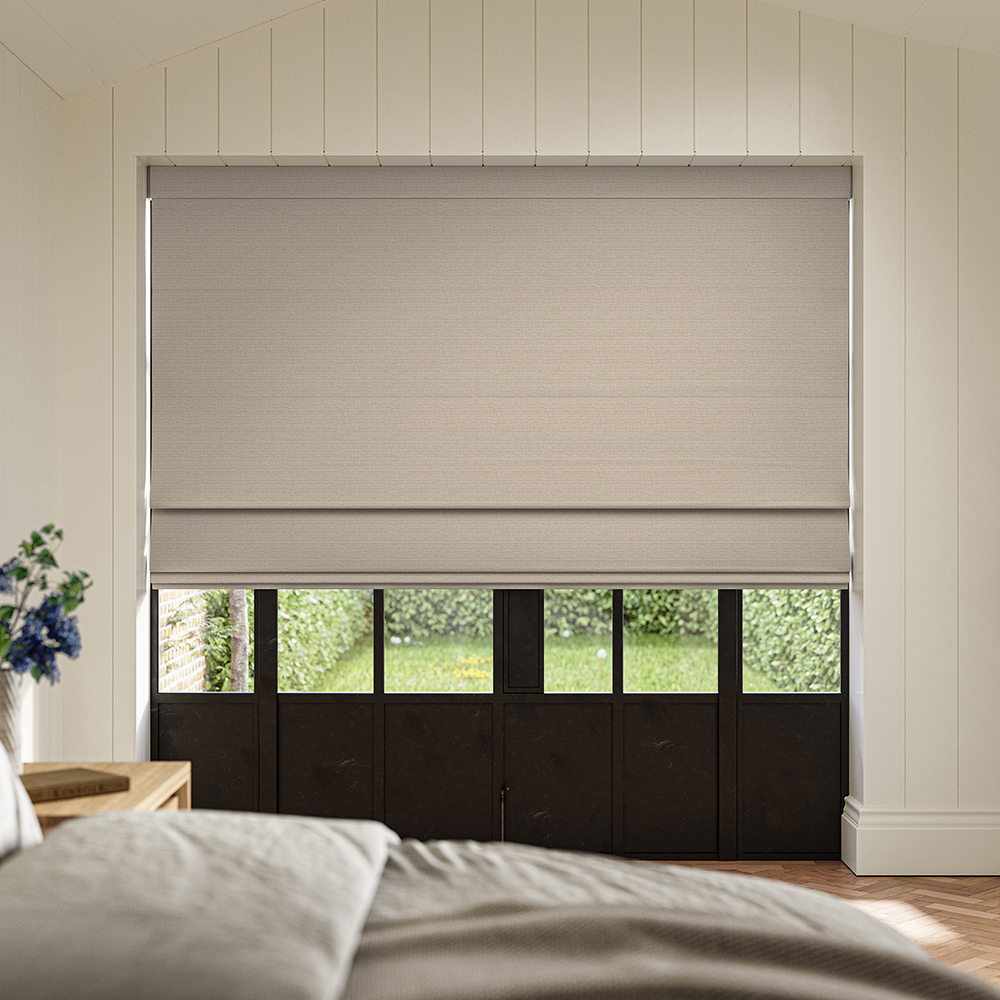
Roman blinds are fabric blinds that fold up into soft pleats as you raise them. They’re the closest a blind gets to a curtain, which is why they suit bedrooms and living rooms where you want the window to feel dressed. We line them in polycotton or satin (both dim-out), blackout, or bonded thermal lining for warmth. You can choose a classic or cassette headrail, and either stacked folds or a waterfall finish.
The trade-off: the folded fabric sits at the top of the window, so a little glass is always covered even when the blind is fully up. They’re also happier in drier rooms. Roman blinds wider than 1300mm have a discreet, pattern-matched seam.
Roller blinds
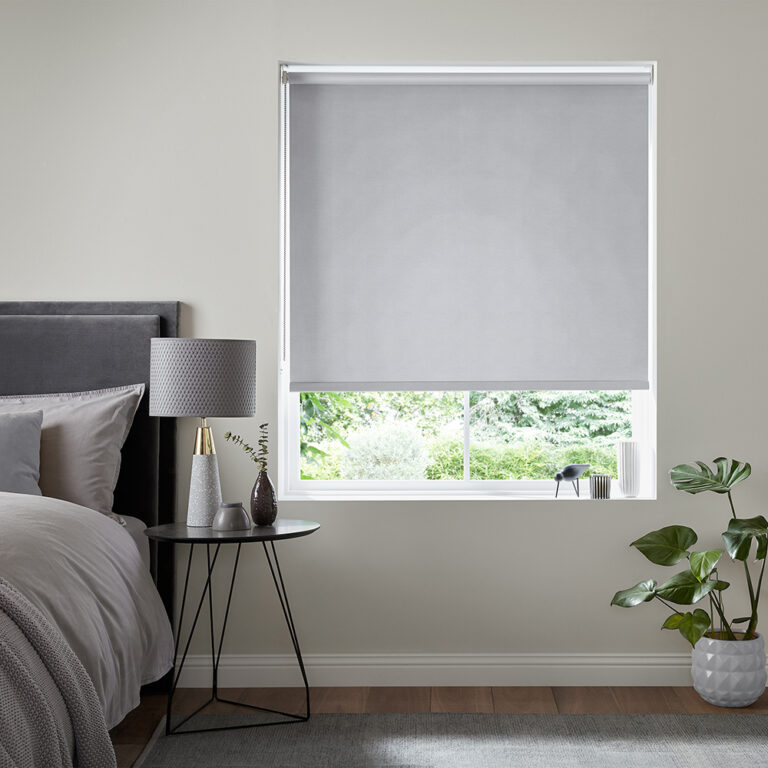
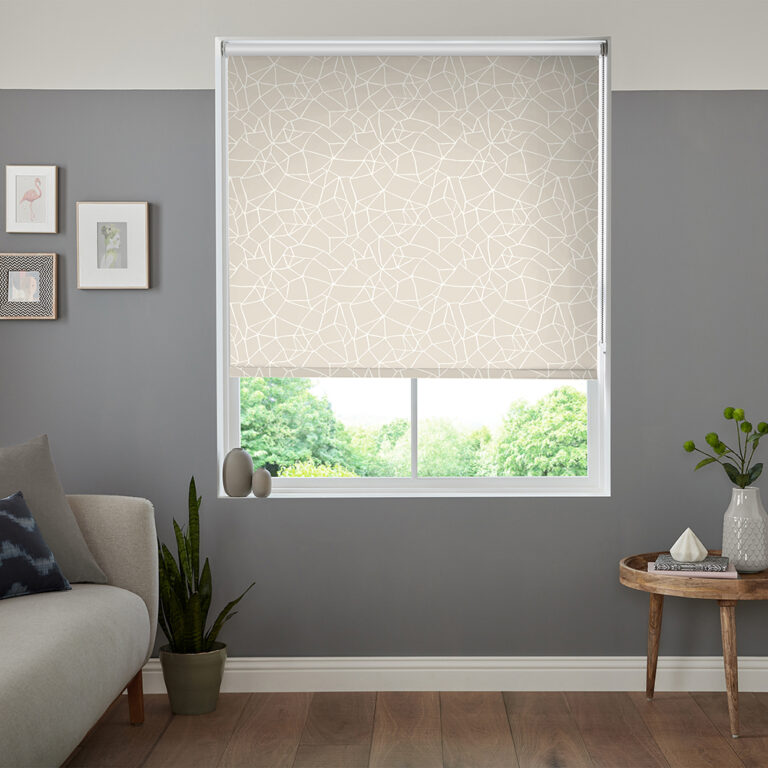
A roller blind is a single piece of fabric on a tube that rolls up neatly at the top. It’s slim, simple and at home in almost any window. Fabrics go from light filtering to blackout, and even on a wide window it’s one panel with no joins.
Vertical blinds
Vertical blinds have hanging slats that turn to angle the light and draw to one side to clear the opening. That makes them a practical answer for wide windows and patio doors, because you can walk straight through. Tilt the slats and you block a direct beam of sun while still seeing out.
Venetian blinds: real wood and faux wood
Venetians have horizontal slats that tilt and lift, so you can let light in while stopping people seeing straight into the room. Real wood brings natural grain and warmth that suits living rooms, studies and period homes. Faux wood gives a similar look but copes better with humidity, so it’s the safer wood-look choice for kitchens and bathrooms.
Fifty50 day and night blinds
Fifty50 blinds are made from alternating sheer and solid bands of fabric. Line the solid bands up and you get privacy; offset them and filtered daylight comes through the sheer stripes. They’re one panel with no joins. They are a privacy blind rather than a blackout one, so they suit living rooms, kitchens and home offices better than a bedroom you need dark.
No-drill blinds
No-drill blinds are Perfect Fit style blinds, made in Roman and roller versions, that fit inside the window recess without drilling. Two things to check before you order: they are recess fit only, and the recess or frame has to be solid. Plasterboard with nothing behind it won’t hold them. They’re handy in rented homes and anywhere you’d rather not put holes in the frame.
Motorised blinds
Roman blinds can be motorised, with a choice of chain, remote, voice control or app. Motorised blinds make sense for high windows, wide spans of glass and anywhere the blind is awkward to reach. With remote, voice or app control there’s no hanging cord at the window, which a lot of parents like. Browse motorised blinds to see what’s available.
Blackout blinds
Blackout blinds use a fabric or lining that stops light passing through the material. They’re the usual pick for bedrooms, nurseries, shift workers and TV rooms. The catch is that light can still leak round the edges of any blind, so how it’s fitted matters as much as the fabric. If you like a softer feel, we also make soft touch blackout blinds.
Light filtering and sheer blinds
Light filtering blinds let daylight in while hiding the detail of the room from outside during the day. They’re good for living rooms, kitchens and home offices, where you want to cut screen glare without switching a lamp on at midday. At night, with the lights on inside, they give much less privacy. Sheer blinds go further still: they soften the view rather than block it, and work best layered with curtains or in rooms that aren’t overlooked.
Waterproof and PVC blinds
Waterproof blinds and PVC blinds are made for wet rooms. Steam and splashes don’t bother them and they wipe clean, so they belong in bathrooms, shower rooms, kitchens and utility rooms.
Which blinds suit each room?
The right blind is the one that matches how the room is used through the day. This is how we’d approach each space.
Bedroom
Start with blackout. A blackout roller is the simplest option, and a blackout-lined Roman blind looks softer and more finished. Fitting it inside the recess and keeping the measurements tight keeps the side gaps small. If you need it darker still, hang curtains in front. Our guide to blackout blinds for bedrooms and nurseries goes into the detail.
Nursery and children’s rooms
Darkness for daytime naps and safety around cords come first. A blackout roller or blackout Roman blind helps a toddler settle at 1pm in June. A motorised Roman blind on remote or app control keeps hanging cords away from the window altogether.
Living room
Living rooms usually need light control more than darkness. A Roman blind looks warm and works well with curtains on a pole in front. A light filtering roller stops glare on the TV without making the room dull. Real wood venetians suit a more structured, classic room. If you want the window to be the focal point, the designer fabrics we make up, such as Orla Kiely, Cath Kidston and Sara Miller, will do it.
Kitchen
Kitchen blinds have to deal with steam, cooking splashes and a window that gets opened all the time. Roller blinds, faux wood venetians and waterproof blinds are the usual answers. Keep anything fabric well away from the hob.
Bathroom
Choose waterproof or PVC blinds, or faux wood venetians. Privacy matters more than light here, so pick a fabric you’re comfortable with when the light’s on at night.
Conservatory
Conservatories have a lot of glass and get hot and bright. Light filtering fabrics take the edge off the glare, blackout fabrics do more to block the sun, and a motorised Roman blind makes high windows practical to open and close. If the window recesses are solid, no-drill blinds leave the frames untouched.
Home office
Screen glare is the main problem. A light filtering roller or a venetian lets you diffuse or angle the daylight and keep working without the main light on. If your workspace needs it, we also make fire retardant blinds.
Bay windows, wide windows and patio doors
Bay windows usually look best with a separate blind in each section so every blind lines up with its frame. Wide windows can take one large roller (still a single panel) or a Roman blind, or two blinds side by side if the span is very large. For patio doors, vertical blinds are often the most practical choice because they draw to one side and you can walk straight out.
How do the main blind types compare?
A general comparison. Your fabric choice can shift things a little.
| Blind type | Best rooms | Light control | Cleaning | Notes |
|---|---|---|---|---|
| Roman | Bedroom, living room, dining room | Dim-out, or full blackout with blackout lining | Professional dry clean | Soft, curtain-like look; folds cover a little glass; can be motorised |
| Roller | Almost any room | Light filtering to blackout, depending on fabric | Wipe with a dry lint-free cloth | Slim and simple; single panel with no joins |
| Vertical | Patio doors, wide windows | Good; slats tilt to angle light | Dust or wipe slats | Walk through without lifting the blind |
| Venetian (real wood) | Living room, study | Very good; tilt slats | Dust slats regularly | Warm, natural look; keep out of steamy rooms |
| Venetian (faux wood) | Kitchen, bathroom | Very good; tilt slats | Wipe clean | Wood look that copes with humidity |
| Fifty50 | Living room, kitchen, office | Switch between privacy and filtered light | Dust gently | Alternating sheer and solid bands |
| No-drill | Solid window recesses | Depends on fabric | As per fabric | Roman or roller; recess fit only |
| Blackout | Bedroom, nursery, TV room | Blocks light through the fabric | As per blind type | Edges can still let light in |
| Light filtering | Living room, office, kitchen | Softens light and glare | As per blind type | Less privacy at night with lights on |
| Waterproof / PVC | Bathroom, kitchen, utility | Depends on fabric | Wipe clean | Built for steam and splashes |
Stuck between the two most popular types? Our Roman blinds vs roller blinds guide compares them head to head.
How do you measure for blinds?
Decide first whether the blind sits inside the window recess (recess fit) or on the wall outside it (exact fit). Then measure width and drop at more than one point. A recess fit looks neat and leaves the sill clear. An exact fit covers more and can make a small window look bigger.
- Use a metal tape and work in millimetres. Measure the width first, then the drop.
- For a recess fit, measure the width in three places and give us the smallest. Do the same for the drop. We make recess blinds about 10mm narrower than the recess so they run freely, so don’t take anything off the width yourself. If you’re measuring the drop to the sill, deduct 10mm.
- For an exact fit, measure the area you want to cover and allow at least 100mm overlap on each side to cut down light gaps.
Our step-by-step blind measuring guide covers each type in detail.
What about child safety?
Any blind with a cord or chain needs fitting with children in mind. Our corded blinds come with breakaway clips, and looped chains are supplied with a child-safety P-clip that you fix to the wall. Keep cords and chains out of reach, and move cots, beds and anything climbable away from the window.
For a child’s room, a motorised Roman blind on remote, voice or app control means there’s no hanging cord at all. If you’re unsure about a particular blind, ask us before you order.
How do samples and made to measure work?
The best way to choose a fabric is to see it at your own window. You can order up to five free fabric samples per order. They come through the letterbox in 2 to 3 working days and you don’t need to send them back. Hold each one up in morning and evening light and see how much comes through.
We recommend sampling because made to measure blinds are made for your window. Once production has started they can’t be cancelled or returned for a change of mind, though anything faulty or made incorrectly is repaired, replaced or refunded. Blinds usually arrive within 10 to 14 working days of order confirmation. Delivery to mainland UK is free on orders over £150, and £15 under that.
To clean them, wipe with a dry lint-free cloth. Roman blinds should be professionally dry cleaned.
Can Greenlane fit your blinds in Leicester?
Yes, we offer a local installation service for blinds. If you’d rather fit them yourself, our blind fitting guide takes you through it. A level bracket and a snug fit help a blind run smoothly and keep light gaps small.
You’re also welcome at the showroom on Green Lane Road. We’re open Monday to Friday 9am to 5.30pm and Saturday 11am to 5.30pm, closed Sunday. If you can’t get in, we also do video consultations.
Quick answers
What is the most versatile blind?
A roller blind. It suits almost any window, comes in fabrics from light filtering to blackout, and is a single panel with no joins.
What blinds are best for a bathroom?
Waterproof or PVC blinds, or faux wood venetians. They handle steam and wipe clean.
Do blackout blinds make a room completely dark?
They block light through the fabric, but some light can get round the edges. A tight recess fit, or curtains in front, reduces the gap.
Can I have blinds without drilling?
Yes, if the window has a solid recess. Our no-drill Roman and roller blinds fit inside the recess without drilling; they can’t be fitted outside it.
Can blinds be motorised?
Roman blinds can, with chain, remote, voice or app control. It’s a good option for high or hard-to-reach windows.
Find the right blind for your room
Browse all our made to measure blinds, get your samples in first, and if you’re in Leicester, pop into the showroom at 58-68 Green Lane Road, LE5 3TH, or call us on 0116 251 1470.