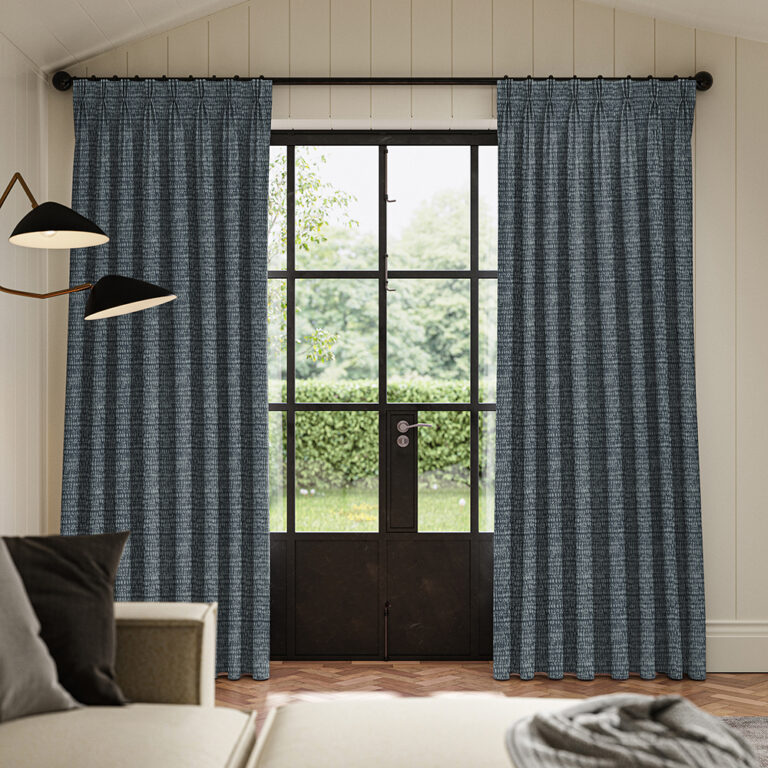

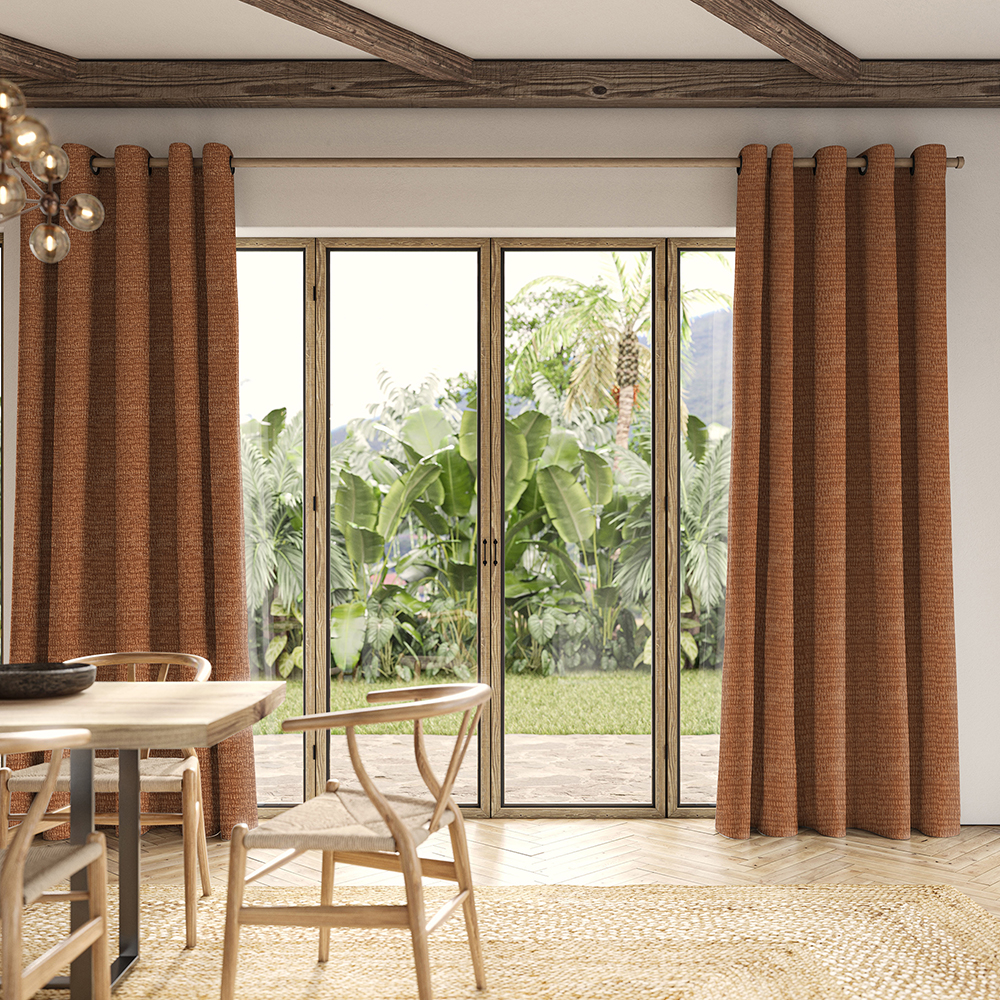
This curtains UK guide starts with one question for every room: what do you need the curtains to do? In a bedroom it’s darkness. In a living room it’s warmth and a bit of presence. In a kitchen it’s staying out of the way of the hob. Pick the lining and the length for that job first, then choose the heading, fabric and colour you actually like.
Below we go room by room, then through headings, linings, lengths, measuring and poles versus tracks, using the figures we make our curtains to.
Which curtains are best for a living room?
For most living rooms, lined floor-length curtains in a medium to heavy fabric are the right call. They frame the window, hold heat in on winter evenings and make the ceiling look higher than it is.
Think about how the room gets used. If the TV faces a sunny window, a blackout lining cuts the afternoon glare. If the room faces north and always feels a little cold, add interlining: it’s an extra layer between the face fabric and the lining that gives the curtain more weight and drape, and makes the room feel warmer once they’re drawn.
Pencil pleat and pinch pleat both look smart in a lounge. Eyelets feel more relaxed and modern. Our living room curtains run from soft plain textures to bold prints, and velvet is worth a look if your lounge is the room that’s freezing in January.
Which curtains are best for a bedroom?
Blackout-lined curtains suit most bedrooms. If you work shifts, sleep lightly or have an east-facing room where the sun is up hours before you, don’t skip the blackout lining.
Curtains on their own rarely give total darkness, though. Light creeps in over the top and round the sides. If you want the room properly dark, fit a blackout blind in the recess and hang the curtains in front. The blind deals with the glass, and the curtains cover the gaps around it.
Is there a radiator under the window? Then go for sill or below-sill length so the heat comes into the room rather than getting trapped behind the fabric. Otherwise floor length gives a bedroom a calm, finished look. Browse our bedroom curtains to see the full range.
What curtains work in a nursery or child’s room?
Blackout curtains are the most useful thing you can hang in a nursery. Daytime naps and light summer evenings are far easier in a dark room, and pairing the curtains with a blackout blind gets you closer still.
Safety comes first. Keep tie-backs, cords and blind chains well out of reach, and don’t put the cot or bed right next to the window.
Prints are fun here, but choose something that can grow with the child. A soft floral or a simple stripe will still look right when the toddler is ten. We have a small range of nursery and kids’ curtains alongside the main collection.
What curtains suit a kitchen?
Kitchen curtains should be short and kept well clear of the hob, the toaster and the sink. Sill length is the usual choice, because the fabric stays off the worktop and away from splashes.
One thing to know before you order: our made to measure curtains should be professionally dry cleaned, not put in the washing machine. That’s why a lot of people put a blind in the kitchen instead, or a blind with a short curtain at the sides for softness. Compare our kitchen curtains with our kitchen blinds, and for the window over the sink, a waterproof blind is the practical answer.
Can you hang curtains in a conservatory?
Yes. Curtains make a conservatory feel like a proper room and help hold heat on cold evenings. Choose lined curtains for warmth and stick to lighter colours, because strong sun through all that glass can fade darker fabrics over time.
Curtains usually work best on the doors and on the wall facing the garden, with blinds on the side windows. Our no-drill blinds fit inside a window recess without drilling, as long as the recess is solid, which helps if you’d rather not put holes in the frames.
How do you dress a bay window?
The neatest way is a bendable track or a bay pole that follows the shape of the window, with curtains drawing all the way round. You get full cover at night, and in the day the curtains stack back at each end.
Other ways to do it:
- One pair per section, each window in the bay on its own pole or track.
- A straight pole across the opening of the bay, with the curtains closing in front of it. Simple, but you lose the bay as usable space when they’re drawn.
- A blind in each window for light and privacy, with dress curtains at either end for softness.
Bays are where measuring goes wrong most often. Measure each section separately, note the angles, and take your time. If you’re local, our installation service can fit the track and curtains for you.
Which curtain heading should I choose?
The heading decides how the curtain hangs and how much fabric goes into it. Pencil pleat is the flexible all-rounder, pinch pleat is the tailored one, eyelet is the relaxed modern one, and wave is the clean contemporary look on a track. These are the figures we make to.
| Heading | Fullness | Details | Best for |
|---|---|---|---|
| Pencil pleat | 200% | 3″ or 6″ tape | Most rooms, poles and tracks, bay windows |
| Double pinch pleat | 200% | Pleat groups about 10cm apart | Living rooms and bedrooms where you want a tailored look |
| Triple pinch pleat | 260% | Pleat groups about 10cm apart, fuller folds | Formal rooms, tall windows, heavier fabrics |
| Eyelet | 150% | 40mm or 50mm eyelets; poles up to 28mm for 40mm eyelets, up to 38mm for 50mm | Modern rooms, poles only |
| Wave | Ask us | Soft, even waves about 110mm deep | Contemporary rooms, long runs of glass |
Fullness is how much wider the fabric is than the pole or track. At 200%, a 150cm pole takes 300cm of fabric across the pair. More fullness means deeper folds.
Two practical differences people don’t expect. Pencil pleat curtains arrive flat, ungathered and without hooks, so you pull the tape to your width and add hooks yourself. Pinch pleat curtains arrive with the pleats sewn and adjustable hooks already attached. Eyelet curtains need a pole that fits through the eyelet, so check the diameter before you order. For a closer look at the pleated options, read our pinch pleat curtains guide.
Do I need blackout lining or interlining?
Want darkness? Choose blackout. Want warmth and a heavier drape? Add interlining. Almost every curtain is better with some lining, because it helps the fabric hang and protects it from the sun.
- Polycotton lining (ivory or white) is dim-out. It gives the curtain body and cuts some light, but daylight still comes through.
- Satin lining (ivory or white) is also dim-out, with a smoother finish.
- Blackout lining blocks most light. It’s the one for bedrooms, nurseries and rooms where you watch a lot of TV.
- Interlining is an extra layer added inside the curtain. It adds drape and warmth, which helps in older houses, north-facing rooms and rooms where the front door opens straight in.
- Sheer fabrics can’t be lined. They’re meant to let light through.
A lot of people layer: sheers for daytime privacy, with lined curtains in front for the evening. Our curtain lining guide covers each option in more detail.
How long should curtains be?
There are three usual lengths, and each suits a different window.
- Sill length finishes about 1cm above the windowsill. Good for kitchens, deep sills you use for plants, and windows above a bed or worktop.
- Below sill finishes about 15cm under the sill. A sensible choice where there’s a radiator beneath the window.
- Floor length finishes about 1cm above the floor. The classic choice for living rooms and bedrooms, and it makes windows look taller.
Some people like a puddle, where the fabric breaks on the floor by a few centimetres. It looks soft, but it gathers dust and isn’t much fun with pets or a vacuum cleaner. Also bear in mind that made to measure curtains have a drop tolerance of up to 20mm, so don’t plan floor-length curtains to skim the floor with no margin at all.
How do I measure for curtains?
Measure the pole or track, not the window, and measure the drop from where the curtain hangs to where you want it to finish. Use a metal tape and work in millimetres. Give us the pole or track size, not a curtain size: we work out the fabric from that.
- Fit the pole or track first if you can. It’s much easier to measure accurately from something that’s already up.
- Width: on a pole, measure between the finials. On a track, measure end to end. If the pole isn’t up yet, allow 200 to 300mm beyond the window on each side if you have the space, so the curtains can stack back off the glass.
- Drop on a pole: measure from the bottom of the curtain ring (or the top of the pole for eyelets) to where you want the curtain to finish.
- Drop on a track: measure from the top of the track to the finish point.
- Take three drop measurements across the width. Floors and ceilings are rarely level, so use the shortest.
Hang the pole 10 to 15cm above the window frame, or higher if you’ve room. Raising it makes the window look taller. Our curtain measuring guide walks through it with diagrams.
Should I use a curtain pole or a track?
Use a pole when you want it on show, and a track for a clean look or a curved window. A pole becomes part of the design. A track hides away and lets the fabric do the work.
| Pole | Track | |
|---|---|---|
| Look | Decorative, part of the room | Discreet, often hidden |
| Headings | Pencil pleat, pinch pleat, eyelet | Pencil pleat, pinch pleat, wave |
| Bay windows | Needs a bay pole or one per section | Bendable tracks follow the bay |
| Heavy curtains | Needs a strong pole and brackets | Wall or ceiling fixing |
We sell curtain poles and tracks. Our curtains are hand-drawn, not motorised, so if a window is too high or awkward to reach, a motorised Roman blind is the better fit there. If you’d rather not do the drilling yourself, see our curtain fitting guide, or ask about our local installation service.
How do I choose colour and pattern?
Work from the walls and the sofa or bedding, then decide whether the curtains should stand out or blend in. They cover a big area, so they change the feel of a room more than most things you’ll buy for it.
- To blend in, pick a colour close to the walls, a shade lighter or darker. Plain, natural and cream fabrics do this well.
- To stand out, go for a contrast against pale walls: blue, green and teal, or grey and black.
- For pattern, florals sit happily in cottage and period rooms, while geometrics and stripes suit modern ones.
- In south-facing rooms, strong colours can fade over time. A lining helps protect the face fabric.
Lined curtains look different with daylight behind them. Hold your sample up at the window during the day, then look at it again in the evening under your own lamps.
Which designer curtain ranges do you stock?
We make curtains in fabrics from several well-known designer names, so you can have the print you love made to fit your window. The curtain ranges are:
- Orla Kiely
- Emily Bond
- Cath Kidston
- Sara Miller
- Sophie Allport
- Voyage Maison
- Shabby Chic by Rachel Ashwell
- Bluebellgray
- Wee Blue Bell
All of these are also available as blinds, so you can put a Roman blind in the kitchen that matches the curtains in the dining room.
How do samples and made to measure work?
Order free fabric samples first, then order the curtains once you’re sure. You can have up to five with each sample order. They come through the letterbox in 2 to 3 working days and you don’t need to send them back.
We push sampling because made to measure curtains are made to your sizes. Once production has started they can’t be cancelled or returned for a change of mind, only repaired, replaced or refunded if they’re faulty or made incorrectly. Seeing the fabric in your own light, next to your own walls, is the best way to avoid a surprise.
After you order, made to measure curtains and blinds usually arrive within 10 to 14 working days. Delivery to mainland UK is free on orders over £150 and £15 below that. Curtains wider than 1300mm include discreet, pattern-matched seams, which is normal for wide made to measure curtains. When they arrive, dress them and tie them loosely for 48 hours so the pleats set.
Quick answers
Which curtains are best for a bedroom?
Blackout-lined curtains suit most bedrooms. Add a blackout blind behind them if you want the room properly dark.
What length should living room curtains be?
Floor length, finishing about 1cm above the floor, suits most living rooms. Go below-sill if there’s a radiator under the window.
How much fullness do curtains need?
We make pencil pleat and double pinch pleat at 200% fullness, triple pinch pleat at 260% and eyelet at 150%.
Can you get motorised curtains?
Not from us: our curtains are hand-drawn. Roman blinds can be motorised, with chain, remote, voice or app control.
Can I get curtain samples before ordering?
Yes. Up to five fabric samples are free, arrive in 2 to 3 working days and don’t need returning.
Start choosing your curtains
Browse all our made to measure curtains and get a few samples in before you decide. If you’re in Leicester, come and see the fabrics at our showroom at 58-68 Green Lane Road, LE5 3TH (Monday to Friday 9am to 5.30pm, Saturday 11am to 5.30pm), or call us on 0116 251 1470.